

The pullback coincided with reports of a stalled regulatory bill and expectations of a Federal Reserve rate hike.
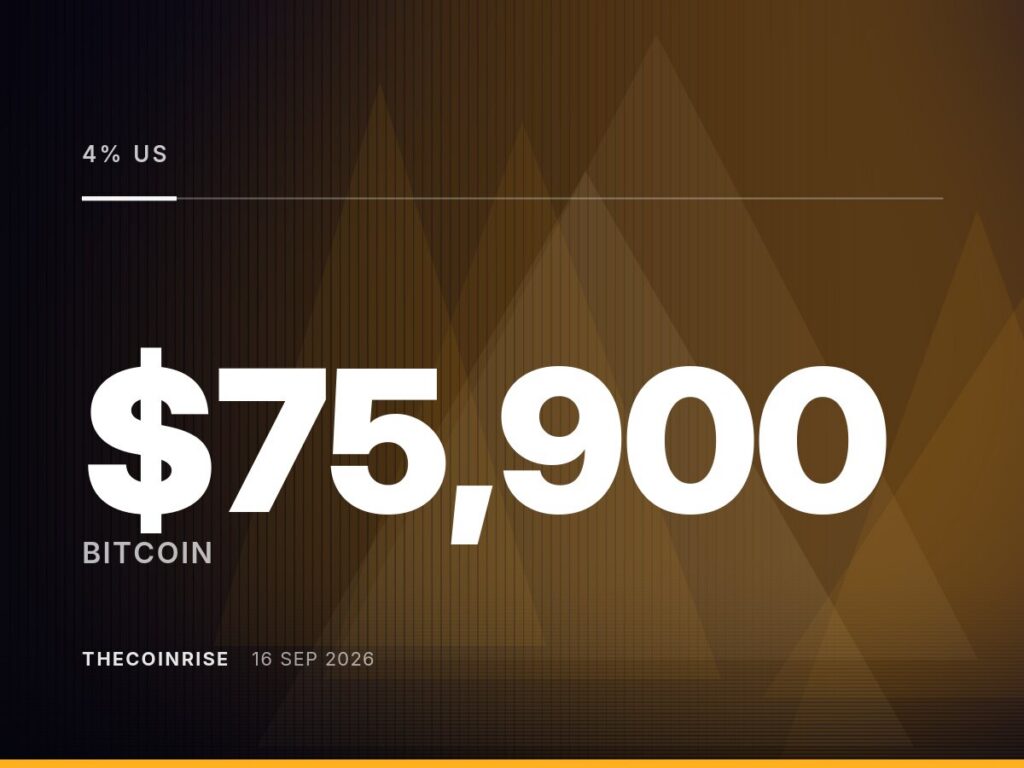
Bitcoin dropped about 4% during the US trading session before stabilizing near $75,900, according to Cryptonews.com. The move marked one of the sharper single-session declines for the asset in recent weeks, though prices found a floor before the close.
The Cryptonomist EN reported that the pressure on Bitcoin’s price coincided with two separate developments. A key regulatory bill affecting the crypto industry appeared to stall in the legislative process. At the same time, markets increasingly priced in the possibility of an upcoming Federal Reserve interest rate hike.
Neither development was confirmed as the direct cause of the price move by the reporting outlets. Both were described as forming the backdrop against which the drop occurred. Traders often watch regulatory and monetary policy signals closely, given their potential to shift sentiment quickly across digital asset markets.
A stalled regulatory bill can leave market participants without clarity on rules governing custody, trading, or classification of digital assets. Uncertainty of this kind has historically weighed on risk appetite in crypto markets. Investors sometimes reduce exposure when legislative timelines slip, preferring to wait for clearer guidance before committing capital.
Expectations of a Federal Reserve rate hike carry separate implications. Higher interest rates tend to increase the appeal of safer, yield-bearing assets. That can draw capital away from more volatile holdings, including Bitcoin and other cryptocurrencies. Markets often react to rate hike expectations well before any official decision, pricing in anticipated moves ahead of time.
The stabilization near $75,900 suggests buyers stepped in after the initial decline. Whether this level holds depends on how the regulatory and monetary policy narratives develop in coming sessions. Market participants will likely watch for further news on the stalled bill and any official signals from the Federal Reserve.
Bitcoin’s price action during US trading hours often reflects a mix of macroeconomic data releases, regulatory headlines, and broader risk sentiment among institutional and retail traders. The overlap of two separate pressure points in a single session can amplify volatility beyond what either factor alone might produce.
Sources disagree on this story
This article was published before the reports below were compared. The reporting above stands; what follows is where the published accounts do not agree.
Cryptopolitan and TronWeekly give opposite vote counts for the failed Senate procedural vote on the CLARITY Act, while outlets also diverge on how much Bitcoin actually fell.
What all sources agree on
- The US Senate failed to advance the CLARITY Act in a procedural vote.
- The bill needed 60 votes to advance and did not get them.
- Bitcoin fell in price around the time of the vote.
- Markets are also pricing in a possible Federal Reserve interest-rate hike.
Where the reports disagree
1Senate procedural vote tally on the CLARITY Act
The procedural vote on the CLARITY Act ended with 49 senators in favor and 50 against.
Reuters indicated that 50 votes were in favor of the act while 49 were against.
What would settle it: The official Senate roll call vote record.
2Size of Bitcoin's price drop
Bitcoin price fell 4% in US trading and stabilized at around $75,900 as of 8 a.m. in London.
The setback dragged Bitcoin down 4% in US trading before the token found its footing around $75,900 in London hours later, according to Bloomberg.
Bitcoin (BTC) fell 2.1% in the last 24 hours, and has dropped 4.1% over the past week.
Bitcoin fell as much as 5% to $76,110, extending losses that had started before the Senate vote.
Bitcoin price has declined roughly 2.08% over the last 24 hours.
What would settle it: Exchange-level OHLC price data for the specific time window cited by each outlet.
3Probability priced for a Fed rate hike
Reuters reported on Sept. 14 that traders assigned an 85% likelihood to a rate hike on Wednesday following hot inflation data.
Markets were pricing an 86%-87% chance of a 25-basis-point Federal Reserve rate hike ahead of the Sept. 16 decision, per crypto.news.
Futures were pricing in a 92% chance of a quarter-point hike Wednesday, while the odds of another quarter-point increase stood at 45% for October and 30% for December.
What would settle it: CME FedWatch tool data snapshot at the time each report was filed.
4Bitcoin's price level after the drop
Bitcoin's level near $75,900 at 8 a.m. in London marked the point of stabilization reported by Bloomberg.
Bitcoin fell as much as 5% to $76,110 after the Senate failed to advance the CLARITY Act.
Bitcoin fell to an intraday low of $74,900.
What would settle it: Exchange order-book/trade data for the relevant timestamps.
What to make of it
Treat the CLARITY Act's failure to advance and the general presence of Fed rate-hike pressure as established; treat the exact Senate vote count, the precise size of Bitcoin's drop, and the specific rate-hike probability as unresolved until a primary source (the Senate roll call, exchange trade data, or CME FedWatch) is checked.
Market Impact
A 4% intraday move in Bitcoin can ripple across the broader crypto market, given the asset's role as a benchmark for sentiment. Altcoins and crypto-linked equities often move in tandem with Bitcoin during sharp swings, amplifying volatility across portfolios.
If the regulatory bill remains stalled, uncertainty could persist, potentially keeping a lid on risk appetite for crypto assets in the near term. Similarly, confirmation of a Federal Reserve rate hike could add further pressure, as higher rates typically reduce demand for non-yielding assets like Bitcoin. Traders will likely monitor both threads closely for signs of resolution or escalation.
Bitcoin's stabilization near $75,900 offers a temporary pause after a volatile session. Further direction may hinge on developments in Washington and at the Federal Reserve.
Frequently Asked Questions
Why did Bitcoin's price drop 4% during the US session?
Reports linked the decline to a stalled regulatory bill and expectations of a Federal Reserve interest rate hike, though neither was confirmed as the sole cause.
What price level did Bitcoin stabilize near after the drop?
Bitcoin found support and stabilized near $75,900 following the intraday decline, according to reporting from Cryptonews.com.
How could a Federal Reserve rate hike affect Bitcoin's price?
Higher interest rates can make safer, yield-bearing assets more attractive, potentially drawing capital away from volatile assets like Bitcoin.
What is the significance of the stalled regulatory bill?
A stalled bill leaves uncertainty around crypto industry rules, which can weigh on investor sentiment until clearer legislative direction emerges.