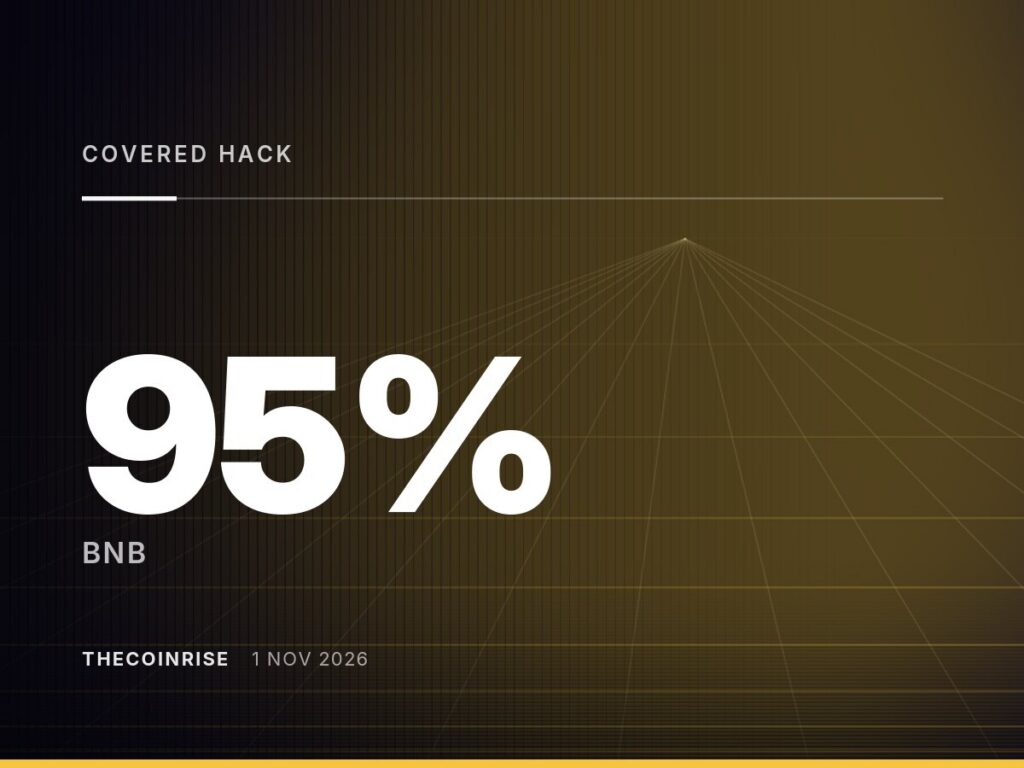


The exchange confirms it drew on its insurance reserve after a security breach, prompting users to ask whether normal withdrawals are still possible.
Binance has told users that 95% of losses stemming from a recent hack have been covered, according to a report from AMBCrypto. The statement has prompted immediate questions from traders about whether withdrawals from the exchange are functioning normally in the aftermath.
A separate report from crypto.news adds that Binance drew on its insurance fund to address the shortfall. That fund, commonly referred to across the industry as a security reserve, exists specifically to backstop user losses in the event of a breach or exploit. The crypto.news report frames an open question about how much capacity remains in that reserve after the payout.
Insurance funds like this one serve as a financial buffer for centralized exchanges. They are typically built up over time through a portion of trading fees or other revenue streams. When a hack or exploit occurs, the fund can be used to reimburse affected users without forcing the exchange to liquidate other assets or pass losses directly onto customers.
The 95% figure disclosed by Binance suggests the exchange absorbed the bulk of the financial damage from the incident. It leaves open the status of the remaining 5%, including whether those losses will be covered through additional measures or remain outstanding. Neither report detailed the exact size of the hack in dollar terms or the specific accounts affected.
For users, the more pressing concern is operational. Exchange hacks often trigger temporary suspensions of deposits or withdrawals while security teams investigate and patch vulnerabilities. Historically, major exchanges have paused withdrawal functions during such events to prevent further exploitation, even when user funds are later made whole. Whether Binance has taken similar precautions this time, or whether withdrawals continue uninterrupted, is central to the question raised in the AMBCrypto report’s own headline.
Transparency around incidents like this matters for the broader market. Centralized exchanges hold custody of user assets, meaning customers rely on the platform’s own disclosures to understand their exposure. A hack that is quickly and largely covered can reinforce confidence in an exchange’s risk management. One that leaves unresolved questions about fund depletion or withdrawal access can have the opposite effect, particularly among users already cautious about counterparty risk following previous industry failures.
The use of an insurance fund also puts a spotlight on exchange reserve policies generally. Users and analysts often look to published reserve figures, proof-of-reserve reports, and fund balances as indicators of how well-capitalized a platform is to absorb future shocks. A payout of this scale, even if it covers the vast majority of losses, is likely to renew scrutiny of how such funds are sized, replenished, and disclosed going forward.
Sources disagree on this story
This article was published before the reports below were compared. The reporting above stands; what follows is where the published accounts do not agree.
AMBCrypto and crypto.news put Binance's hack losses at roughly $6.3 billion, while Coinpedia reports the same 95%-covered recovery against a $3.3 billion hack.
What all sources agree on
- Binance resumed withdrawals on November 1.
- Binance named three sources for covering stolen funds: SAFU, the Futures Insurance Fund, and corporate treasury/balance sheet.
- Binance reported having covered approximately 95% of the losses.
- 7,499 BTC, valued at approximately $581 million, moved from Binance SAFU.
Where the reports disagree
1Total size of the hack
Binance said it has covered $6B, or 95% of the $6.34B in lost funds, and resumed withdrawals on Sunday, the 1st of November.
Binance has used part of its futures insurance fund to help replace assets stolen in its $6.3 billion hack, drawing on a reserve normally used to absorb losses from bankrupt trading positions.
Binance has reportedly covered 95% of the losses linked to its $3.3 billion hack, with withdrawals among the top 10 assets restored.
What would settle it: Binance's own official incident report or audited loss disclosure stating the total value of stolen funds.
2Dollar amount Binance covered under the 95% figure
Binance said it has covered $6B, or 95% of the $6.34B in lost funds
Binance reportedly covered 95% of losses from the $3.3 billion hack.
What would settle it: Binance's own official incident report or proof-of-reserves disclosure stating the dollar value replenished.
What to make of it
Treat the 95%-coverage claim and the resumption of withdrawals on November 1 as established across outlets; do not rely on any single figure for the total hack size ($6.3-6.34 billion vs $3.3 billion) until Binance's own incident disclosure is checked.
Market Impact
News that a major exchange tapped its insurance fund tends to draw attention to custody risk across the sector, even when losses are largely covered. Traders on the affected platform may watch withdrawal processing times closely in the days following such a disclosure, and any delays could amplify concerns beyond the immediate user base.
More broadly, incidents like this often renew debate about self-custody versus holding assets on centralized platforms. They can also increase calls for exchanges to publish clearer, more frequent updates on the size and composition of their insurance reserves, particularly after a fund has been drawn down.
Binance's disclosure that it covered 95% of hack-related losses addresses part of the concern, but leaves open questions about remaining losses, fund capacity, and withdrawal access that users and observers are likely to press for further clarity on.
Frequently Asked Questions
What percentage of hack losses did Binance say it covered?
Binance stated that 95% of losses from the hack have been covered, according to the AMBCrypto report.
Did Binance use its insurance fund to cover the losses?
Yes, according to crypto.news, Binance tapped its insurance fund to address losses stemming from the hack.
Can Binance users withdraw funds normally after the hack?
The reports raise this as an open question rather than confirming current withdrawal status, and no operational details were specified in the available coverage.
What happens to the remaining 5% of losses not covered?
The reports do not specify how the remaining portion of losses will be handled, leaving that detail unresolved as of publication.
What is an exchange insurance fund used for?
It is a reserve built up by an exchange, often from trading fees, used to reimburse users for losses caused by hacks or exploits without liquidating other exchange assets.




Read More
All News


November 22, 2026
Report Flags Quantum Risk to About 6 Million Exposed Bitcoin

November 22, 2026
Bitcoin Rebound: Reports Differ on Liquidation Total

November 22, 2026