

Redemptions from the world's largest spot Bitcoin fund forced a sizable sell-off, marking its steepest outflow stretch since June.
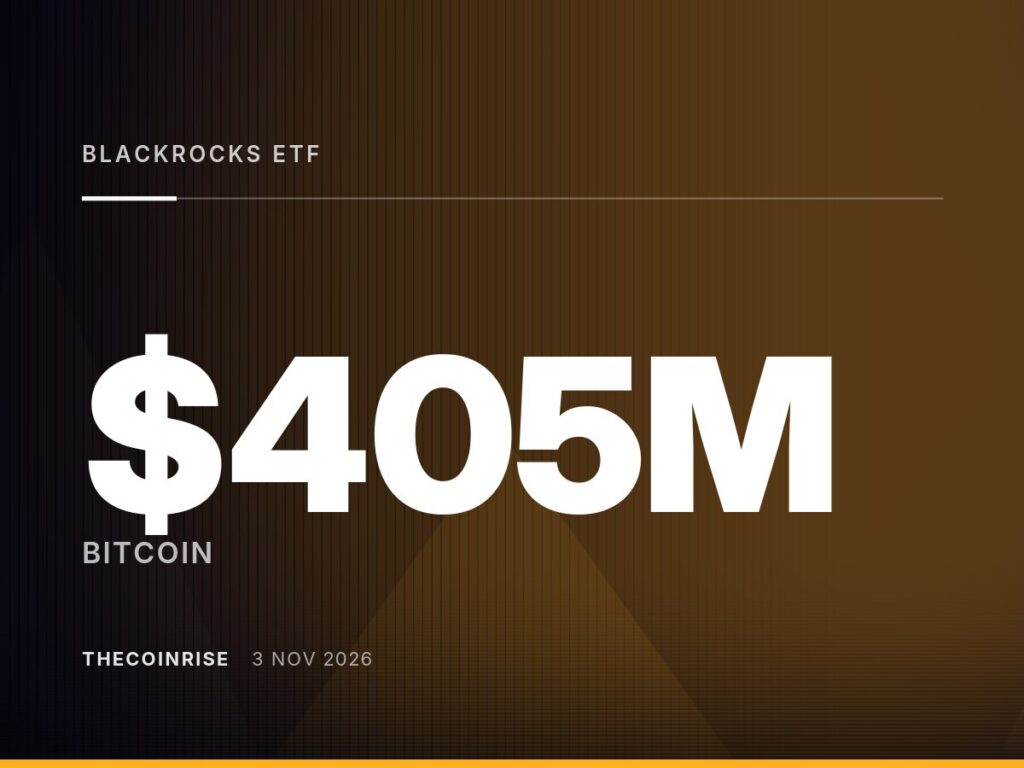
BlackRock sold approximately $405 million worth of Bitcoin linked to its iShares Bitcoin Trust, the exchange-traded fund known by its ticker IBIT. The sale came as redemption requests from fund holders accumulated, forcing the asset manager to reduce its underlying Bitcoin holdings. CryptoBriefing first reported the transaction on November 3.
Separately, Cointelegraph reported that IBIT experienced its biggest outflow period since June. Both outlets point to the same underlying dynamic: investors pulling money out of the fund at a pace that required BlackRock to liquidate part of its Bitcoin reserves to meet redemption demand.
Spot Bitcoin ETFs like IBIT operate on a creation-and-redemption mechanism. When investors buy shares, the fund’s custodian acquires more Bitcoin to back them. When investors sell or redeem shares, the fund must offload a corresponding amount of Bitcoin. This structure means ETF flows can directly influence spot market supply and demand for the underlying asset.
IBIT launched in January 2024 as part of a wave of spot Bitcoin ETFs approved by U.S. regulators. It quickly became the largest such product by assets under management, drawing billions of dollars in net inflows through much of 2024 and 2025. Its scale means that shifts in investor sentiment toward the fund can carry outsized weight for Bitcoin’s broader market structure.
The reported outflow does not necessarily reflect a single cause. Redemptions in ETF products can stem from profit-taking, portfolio rebalancing, macroeconomic concerns, or broader risk-off sentiment across financial markets. Neither CryptoBriefing nor Cointelegraph attributed the redemptions to a specific trigger beyond the volume figures themselves.
Analysts and market participants often watch ETF flow data as a proxy for institutional appetite toward Bitcoin. Sustained inflows have historically coincided with periods of price strength, while outflow stretches have sometimes preceded or accompanied softer price action. The current outflow period, described as the largest since June, suggests a notable shift in short-term demand from this investor segment.
BlackRock has not issued a public statement explaining the redemptions tied to this specific sale. The firm manages IBIT alongside a broad suite of exchange-traded products and has previously described Bitcoin ETFs as part of a long-term strategy to broaden access to digital assets for institutional and retail investors alike.
Sources disagree on this story
This article was published before the reports below were compared. The reporting above stands; what follows is where the published accounts do not agree.
CryptoBriefing dates BlackRock's $405.3 million IBIT Bitcoin transfer to late October, tied to an Oct 23 outflow spike, while Cointelegraph and CoinTurk News EN date the same $405.3 million figure to a Monday in early November, treating October's $515 million as a separate, prior total.
What all sources agree on
- BlackRock's iShares Bitcoin Trust (IBIT) recorded a $405.3 million outflow/sale figure.
- The withdrawals are linked to investors redeeming ETF shares rather than BlackRock choosing to sell on its own account.
- Fidelity's Bitcoin fund is mentioned in the same reporting period (CryptoBriefing notes Fidelity as a co-driver of October 23 outflows; Cointelegraph and CoinTurk note FBTC's $6.7 million inflow on the Monday in question).
Where the reports disagree
1When the $405.3 million IBIT outflow/sale occurred
In late October 2026, the fund moved sizable chunks of its holdings to Coinbase Prime, the institutional trading arm of the exchange.
BlackRock’s Bitcoin ETF shed $405.3 million on Monday as US spot Bitcoin funds opened November with nearly $399 million in net outflows.
BlackRock’s iShares Bitcoin Trust (IBIT) experienced its largest single-day withdrawal since June, as US-listed spot Bitcoin ETFs opened November with heavy outflows.
What would settle it: Farside Investors' daily IBIT flow data for the dates in question, or IBIT's own fund flow disclosures.
2Bitcoin's price at the time of the $405.3 million outflow
Bitcoin itself was trading near $80,000 to $82,000 in late October 2026, roughly when the IBIT transfers took place.
Bitcoin briefly fell below $76,400 on Monday, its lowest level since August, according to CoinGecko. The cryptocurrency traded at around $76,600 at publication, down 3.7% over the past seven days.
At the time of publication, Bitcoin traded around $76,600, reflecting a 3.7% decrease over the last week.
What would settle it: CoinGecko or another price-tracking service's historical price data for the specific date of the $405.3 million outflow.
3Relationship between the $405.3 million figure and October's reported outflow totals
On October 23, 2026, the sector posted a net outflow of $635 million in a single day. BlackRock and Fidelity were the main drivers of that exodus.
The withdrawals followed $515 million in net outflows from US spot Bitcoin ETFs in October.
The trend follows a difficult October for US spot Bitcoin ETFs, which recorded $515 million in net outflows during the month.
What would settle it: Farside Investors' or SoSoValue's monthly and daily net flow breakdowns for US spot Bitcoin ETFs covering both October and November 2026.
What to make of it
Treat the $405.3 million IBIT outflow figure itself, and the broader redemption-driven narrative, as agreed across all three reports; do not treat the specific date, the concurrent Bitcoin price, or how this figure relates to October's $515 million/$635 million totals as settled until the underlying Farside Investors flow data is checked against the date in question.
Market Impact
Large redemptions from a fund the size of IBIT can add selling pressure to Bitcoin's spot market, given the fund's creation-and-redemption structure. A $405 million sale, while a fraction of IBIT's total assets, signals a meaningful shift in flow direction after months of net inflows for many spot Bitcoin ETFs.
Market watchers may treat this outflow stretch as a signal worth monitoring rather than a definitive trend reversal. ETF flow data tends to be volatile week to week, and a single multi-month high in outflows does not by itself establish a sustained pattern. Traders and analysts will likely watch subsequent flow reports to see whether the redemption pace continues or reverses.
The $405 million Bitcoin sale tied to IBIT redemptions highlights how closely spot ETF flows and underlying crypto markets remain linked. Further flow data in coming weeks should clarify whether this outflow period marks a temporary pullback or the start of a longer trend.
Frequently Asked Questions
What is IBIT?
IBIT is BlackRock's iShares Bitcoin Trust, a spot Bitcoin exchange-traded fund that holds actual Bitcoin to back shares traded on U.S. exchanges.
Why did BlackRock sell $405 million worth of Bitcoin?
The sale was tied to investor redemptions from IBIT. When shareholders redeem fund shares, the trust must sell corresponding Bitcoin holdings to meet those requests.
How does this compare to past IBIT activity?
Cointelegraph reported that this marked IBIT's biggest outflow period since June, suggesting a notable shift from the net inflows the fund saw for much of its history.
Does this mean Bitcoin's price will fall?
The reports do not make price predictions. ETF outflows can add selling pressure, but price movements depend on many additional market factors.