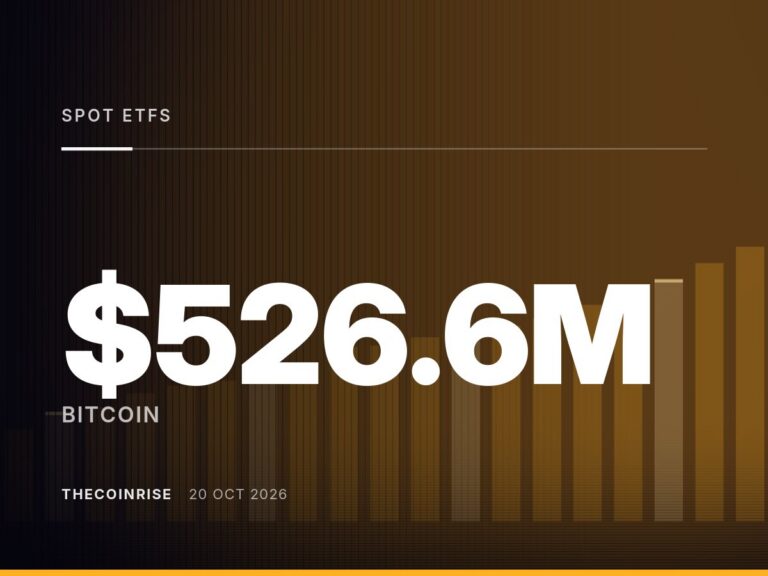


US spot Bitcoin ETFs collectively pulled in roughly $526.7 million in a single session, with BlackRock's fund accounting for most of the total.
US spot Bitcoin exchange-traded funds recorded their best single-day inflow in nearly a month, with roughly $526.7 million entering the category. BlackRock's iShares Bitcoin Trust appears to have driven the bulk of that total, pulling in about $527 million on its own, based on figures reported by multiple outlets.
The near-identical size of the two numbers suggests BlackRock's fund absorbed almost all of the day's net demand across the spot Bitcoin ETF complex. Other issuers in the category saw comparatively modest activity by comparison. This concentration pattern has been a recurring feature of the US spot Bitcoin ETF market since its launch in early 2024, with BlackRock's product consistently capturing a disproportionate share of trading volume and net flows.
The inflow marks the strongest showing for the category since September, according to Cointelegraph. That timing matters because spot Bitcoin ETF flows had cooled in recent weeks amid broader uncertainty in crypto markets. A return to stronger inflows can indicate renewed institutional appetite for regulated Bitcoin exposure, though a single day of data does not establish a durable trend.
Spot Bitcoin ETFs function as a regulated bridge between traditional brokerage accounts and direct Bitcoin exposure. They allow institutional and retail investors to gain exposure to Bitcoin's price movements without directly holding or custodying the underlying asset. Since their approval, these products have become a key gauge of institutional demand for Bitcoin, with daily flow data closely watched by traders and analysts as a proxy for broader market sentiment.
BlackRock's dominance within this category reflects its position as the largest asset manager offering a spot Bitcoin product in the US. The firm's iShares Bitcoin Trust has repeatedly ranked among the largest ETFs by trading volume since its debut, and it has often set the pace for inflows or outflows across the sector. When BlackRock's fund sees a strong inflow day, it frequently coincides with similar movement across the broader category, as was the case here.
Analysts and market participants typically treat these flow figures as one data point among several when assessing institutional sentiment toward Bitcoin. Net inflows do not necessarily indicate sustained buying pressure, since they can reflect short-term positioning, rebalancing, or reaction to broader market catalysts. Nonetheless, a monthly high in net inflows tends to draw attention from traders monitoring institutional participation in the asset class.
Market Impact
A near-monthly-high inflow day for US spot Bitcoin ETFs can be read as a signal of renewed institutional engagement with regulated Bitcoin products. Because BlackRock's fund appears to account for most of the day's total, the figure also underscores how concentrated flow activity remains within the category, with one issuer frequently setting the tone for the broader market.
Traders often use ETF flow data as a sentiment indicator alongside other metrics such as spot price action and derivatives positioning. A single strong inflow day does not guarantee continued demand, but it may prompt closer attention to subsequent daily reports for signs of a sustained shift in institutional allocation toward Bitcoin exposure through regulated vehicles.
The $527 million inflow figure offers a notable data point for a market that had seen cooler ETF flows in prior weeks. Whether this marks a turning point or a one-off event will depend on subsequent daily flow reports across the spot Bitcoin ETF category.
Frequently Asked Questions
What does a $527 million inflow into Bitcoin ETFs mean?
It means investors net-added about $527 million into spot Bitcoin ETF shares on that day, with BlackRock's fund accounting for most of the total reported across the category.
Why is BlackRock's fund central to this figure?
BlackRock's iShares Bitcoin Trust is the largest spot Bitcoin ETF by assets and trading volume in the US, and it has historically driven a large share of net flows across the sector.
Does one strong inflow day indicate a lasting trend?
Not necessarily. Daily ETF flows can reflect short-term positioning or rebalancing, so analysts typically wait for several consecutive days of data before drawing broader conclusions.
How do spot Bitcoin ETFs differ from directly holding Bitcoin?
Spot Bitcoin ETFs let investors gain price exposure to Bitcoin through a regulated brokerage product, without needing to manage private keys or self-custody the underlying asset.