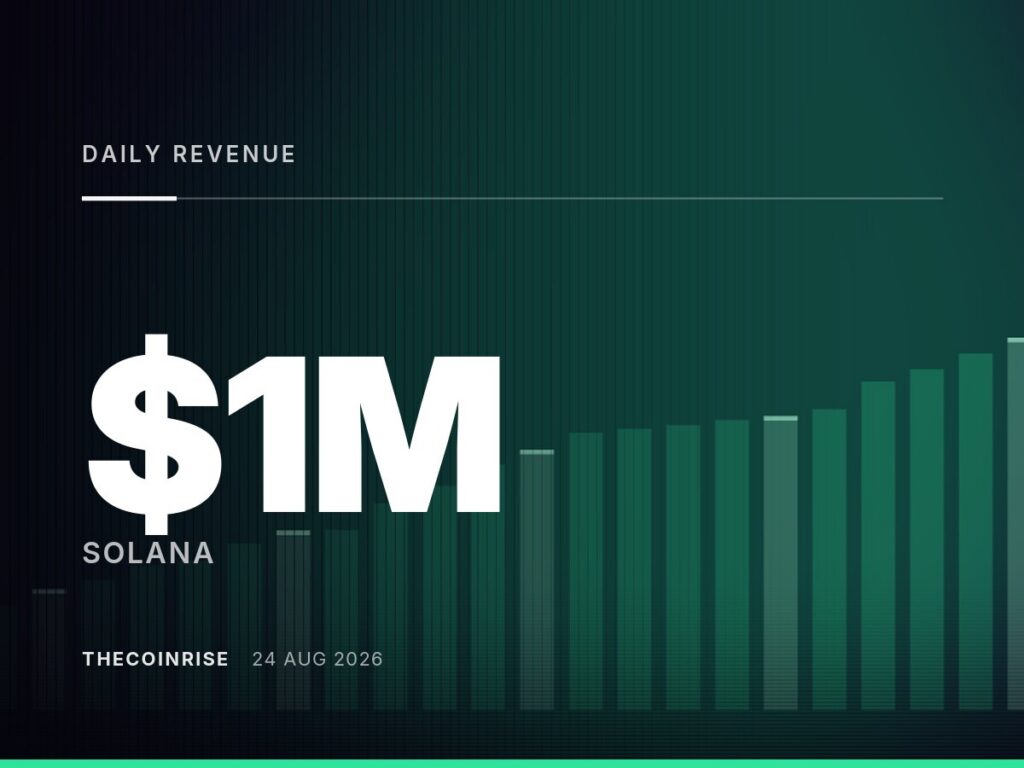


Daily fees and MEV activity pushed Solana's network revenue to its strongest level since early in the year.
Solana's network revenue crossed $1 million on Aug. 19, marking its best single-day showing in six months. The metric captures the total value paid by users to have transactions processed and included in blocks. It includes base transaction fees along with priority fees and revenue tied to maximal extractable value, or MEV, activity.
Network revenue is often used as a proxy for real economic activity on a blockchain. Unlike token price, which can swing on speculation, revenue reflects actual demand for block space. A rising figure suggests more users, traders and applications are competing to have transactions confirmed quickly.
Solana has positioned itself as a high-throughput alternative to Ethereum, emphasizing low fees and fast finality. Its fee structure means that a $1 million day requires a substantial volume of transactions, given that individual fees on the network are typically fractions of a cent. The milestone therefore implies a meaningful uptick in overall usage rather than a handful of large transactions.
The six-month high comes after a period in which activity on many layer-1 networks, including Solana, had cooled from earlier peaks. Network revenue and transaction counts across the broader crypto market have fluctuated throughout 2026, tracking swings in trading volume, decentralized finance activity and speculative trading around new token launches. Solana's ecosystem has been particularly sensitive to activity in memecoin trading and decentralized exchange volume, both of which can drive short-term spikes in fee revenue.
MEV, a component of the revenue figure, refers to profit that validators or searchers can extract by strategically ordering, inserting or excluding transactions within a block. Its presence in Solana's revenue mix has drawn scrutiny from developers concerned about fairness for ordinary users. Even so, MEV activity is generally viewed as a sign that a network carries enough valuable transaction flow to make such strategies worthwhile.
Revenue figures like this one are commonly tracked through on-chain analytics platforms that aggregate fee data directly from blockchain activity. Because the data is derived from the ledger itself, it is considered a relatively transparent gauge of network health compared with metrics that rely on self-reported figures from individual projects.
The timing of the spike, landing on a single day rather than sustaining over a longer stretch, leaves open the question of whether it reflects a durable shift in usage or a temporary surge. Daily revenue figures on most blockchains tend to be volatile, and a single high day does not necessarily indicate a new baseline. Analysts typically look for the metric to hold over subsequent weeks before treating it as evidence of a lasting change in network demand.
Market Impact
A jump in network revenue can influence sentiment around Solana's native token, SOL, since higher fee generation is sometimes read as a sign of stronger fundamental demand. Traders and analysts who track on-chain metrics may view the six-month high as a data point supporting the case that activity on Solana is recovering.
The broader market impact will likely depend on whether the elevated revenue persists beyond a single day. If subsequent daily figures remain closer to prior averages, the Aug. 19 spike may be treated as an isolated event tied to a specific burst of trading or MEV activity, rather than a structural shift in network usage.
The Aug. 19 revenue figure gives Solana watchers a fresh data point, but confirming whether it signals lasting growth will require tracking the network's activity in the weeks ahead.
Frequently Asked Questions
What does network revenue measure on Solana?
It measures the total fees paid by users and validators to process and confirm transactions on the blockchain, including base fees, priority fees and MEV-related revenue.
Why is a $1 million revenue day significant for Solana?
Because individual transaction fees on Solana are typically very small, reaching $1 million in a single day implies a large volume of network activity, marking the highest daily total in six months.
Does higher network revenue mean SOL's price will rise?
Not necessarily. Network revenue reflects on-chain usage rather than price, though some traders view it as one indicator of underlying demand.
What is MEV and why does it matter here?
MEV, or maximal extractable value, is profit validators or searchers can capture by ordering transactions strategically. It contributes to overall network revenue and its presence suggests high-value transaction flow.