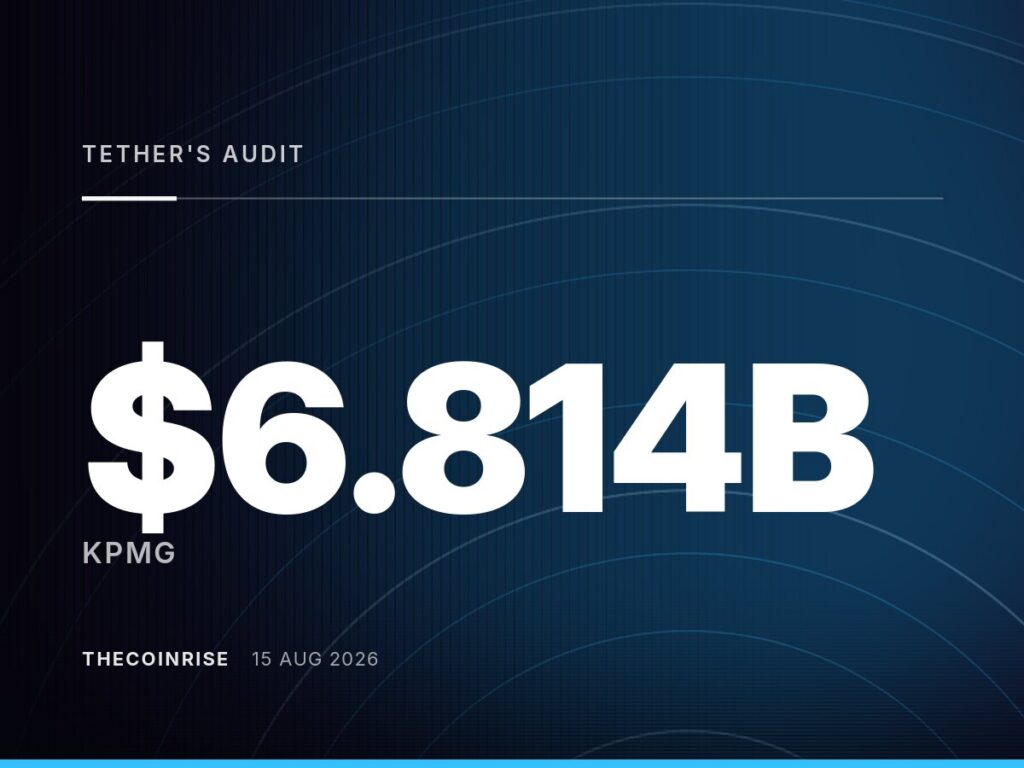


Tether announced on Aug. 13, 2026 that KPMG U.S. had completed its first full independent audit of Tether International, S.A. de C.V.’s 2025 financial statements, giving an unqualified opinion, according to Tether’s statement as reported by CoinDesk. That opinion means KPMG concluded the statements fairly presented Tether’s reserves as of Dec. 31, 2025, when reserves exceeded liabilities by $6.814 billion — but it says nothing about the reserve position on any later date, including Tether’s own more recent attestation showing that buffer had fallen sharply since.
What KPMG actually checked
KPMG’s audit covered the balance sheet, income statement, statement of changes in equity and cash flow statement, and auditors physically counted and inspected every gold bar Tether holds, according to Tether’s own account relayed by CoinDesk, DailyCoin and Bitcoin Magazine. A KPMG spokesperson confirmed to CoinDesk that the firm issued the unqualified opinion but declined further comment, citing client confidentiality.
This is a different exercise from what Tether has published for years. Since settling with the New York Attorney General, Tether has released quarterly reserve reports prepared by BDO Italia. Those are attestations: a check of whether reported reserve assets cover liabilities on one specific date, without testing the underlying transactions, internal controls or valuation methods behind the numbers, per CoinDesk’s own description of the distinction and Eco.com’s summary of the AICPA framework for the two terms. Odaily’s reporting frames it as a difference between a snapshot of a vault and a full examination of how money moved into and out of it, over a period, with controls tested along the way.
Whose books, exactly
The entity KPMG audited is Tether International, S.A. de C.V. — the issuing entity for USDT, according to comments CEO Paolo Ardoino gave to The Block as relayed by Odaily. Tether’s broader corporate structure includes Tether Holdings Limited, Tether Operations Limited and Tether Investments Limited, among other units, per Eco.com’s summary of the group. Odaily reports that in prior BDO attestations, Tether Investments Limited’s assets were explicitly excluded from the definition of reserves — and notes that whether KPMG’s audit scope lines up with that same boundary can only be confirmed by reading the full report, which has not been made public.
The buffer, worked through with the numbers Tether has published
The reserve buffer — reserves minus liabilities — is the number most coverage of this audit has centered on, and it moves quarter to quarter because Tether keeps issuing and redeeming USDT against a reserve pool that itself shifts in value. Here is the sequence as reported across Tether’s own disclosures and outlets covering them:
- As of Sept. 30, 2025, Tether’s reserves stood at $181.2 billion against liabilities of $174.4 billion, a surplus of about $6.8 billion, per Tether’s Q3 2025 BDO attestation as reported by PYMNTS. That attestation broke reserves down to $135 billion in U.S. Treasury exposure, $12.9 billion in gold, $9.9 billion in bitcoin, $14.6 billion in secured loans, $3.9 billion in other investments and $14.7 million in corporate bonds.
- As of Dec. 31, 2025, KPMG’s audit found the surplus at $6.814 billion, per Tether’s Aug. 13, 2026 announcement.
- For Q1 2026, Tether reported total assets of $191.7 billion against liabilities of $183.5 billion, per CrowdfundInsider’s coverage of that attestation, with $141 billion in Treasury exposure, $20 billion in gold and $7 billion in bitcoin.
- By Q2 2026, covering June 30, 2026, BDO’s attestation put the buffer at $4.11 billion, down roughly 40% from the $6.814 billion audited figure six months earlier, according to Odaily and DailyCoin.
The pattern is not a straight decline — the buffer moved through late 2025 and early 2026 before falling by mid-2026 — but the practical point stands: the audited $6.814 billion is a fixed historical marker, not a live reading. During the roughly eight months between the audit date and Tether’s announcement of it, USDT’s circulating supply grew from about $144 billion to about $184 billion, Odaily reports, which is itself a reason the lag matters — a bigger stablecoin supply outstanding means a bigger base the reserve buffer has to keep pace with.
Composition and the parts that stay thin on detail
Across the attestations cited above, U.S. Treasuries make up the large majority of reserves — described as roughly 80% as of Q1 2026 by Eco.com, and in a similar 80%-83% range by Odaily, alongside smaller allocations to overnight repo, money market funds, gold and bitcoin. Odaily also reports that secured loans — a category Tether pledged in 2023 to wind down — still stood at $5.5 billion as of mid-2024. Attestations disclose the loans as an aggregate dollar figure; they do not show who the borrowers are, what backs the loans, or how concentrated the exposure is, per Odaily’s reporting, and a full audit report, if released, would be the more likely place to find that detail in its notes.
The regulatory backdrop
Tether’s transparency push follows two 2021 U.S. settlements. The New York Attorney General required Tether and Bitfinex to pay $18.5 million in February 2021 after finding Tether had misrepresented USDT’s backing during parts of 2017 and 2018, per Eco.com. The CFTC separately ordered Tether to pay $41 million in October 2021, finding that claims USDT was fully backed by dollars were untrue for stretches between June 2016 and February 2019, according to Eco.com and DailyCoin. Neither settlement required an admission of wrongdoing. The current audit lands as Tether also builds out USAT, a U.S.-facing stablecoin the company has positioned as aligned with the GENIUS Act; the law’s federal licensing regime does not extend to Tether’s existing offshore USDT structure because Tether is not U.S.-domiciled, per Eco.com’s summary of the Act. Separately, Odaily reports that the GENIUS Act’s audit requirements do not automatically apply to offshore issuers like Tether, but that Tether is leveraging the KPMG audit to signal proactive compliance to U.S. regulators while pursuing USAT as a parallel path.
The common misreading
An unqualified opinion is a statement that the financial statements were fairly presented on the date they cover — it is not a statement that the reserve assets are free of credit or concentration risk, and it is not an ongoing guarantee. Reading the $6.814 billion figure as a description of USDT’s backing today conflates a one-time audit result with a live reserve position, when Tether’s own subsequent attestation already shows that position had moved by nearly 40% within roughly six months.
What this page does not tell you
It cannot confirm what is inside the KPMG audit report itself — the notes, key audit matters and related-party disclosures — because Tether has not released the document and did not respond to CoinDesk’s request for it as of that outlet’s reporting. It cannot say whether KPMG’s audit scope matches BDO’s definition of reserves, including the treatment of Tether Investments Limited, because that boundary is only checkable against the full report. It cannot say whether Tether will commit to annual audits or retain KPMG going forward; Odaily reports the company has made no such commitment. And it cannot verify the counterparties or collateral behind Tether’s secured loans book beyond the aggregate dollar figures Tether itself has disclosed in its quarterly attestations.
Sources
Every fact above is attributed to one of these reports. Where they disagree, the article says so.