

Most crypto games ask you to click something. This one asks you to trade — and then it fires the shot for you.
TrumpVsMusk.fun is a live, permanent, browser-based war between two memecoin armies. Buy $TRUMP and the red side attacks. Buy $MUSK and the blue side attacks. There are no rounds, no reset, no winner’s screen. The front line sits wherever the market last left it, and the next trade moves it again. It is a spectacle you watch, not a game you install — and every bullet in it is a real on-chain transaction.
In short
- Two tokens, $TRUMP ARMY and $MUSK ARMY, both live on Robinhood Chain and launched through the PONS launchpad.
- Trading activity is read straight off the chain and converted into an animated 3D battle in your browser, in near real time.
- Battle Power decides who is winning: 40% trading volume, 30% price performance, 30% market-cap growth — all measured relative, so the bigger token can never just sit on the lead.
- Every holder is literally a soldier. Ten holders, ten figures on the field.
- Wash trading is filtered out before it counts. Volume you fake against yourself does not fire a bullet.
The idea: the market is the controller
The pitch is one sentence long. A live internet spectacle where the market literally controls a war.
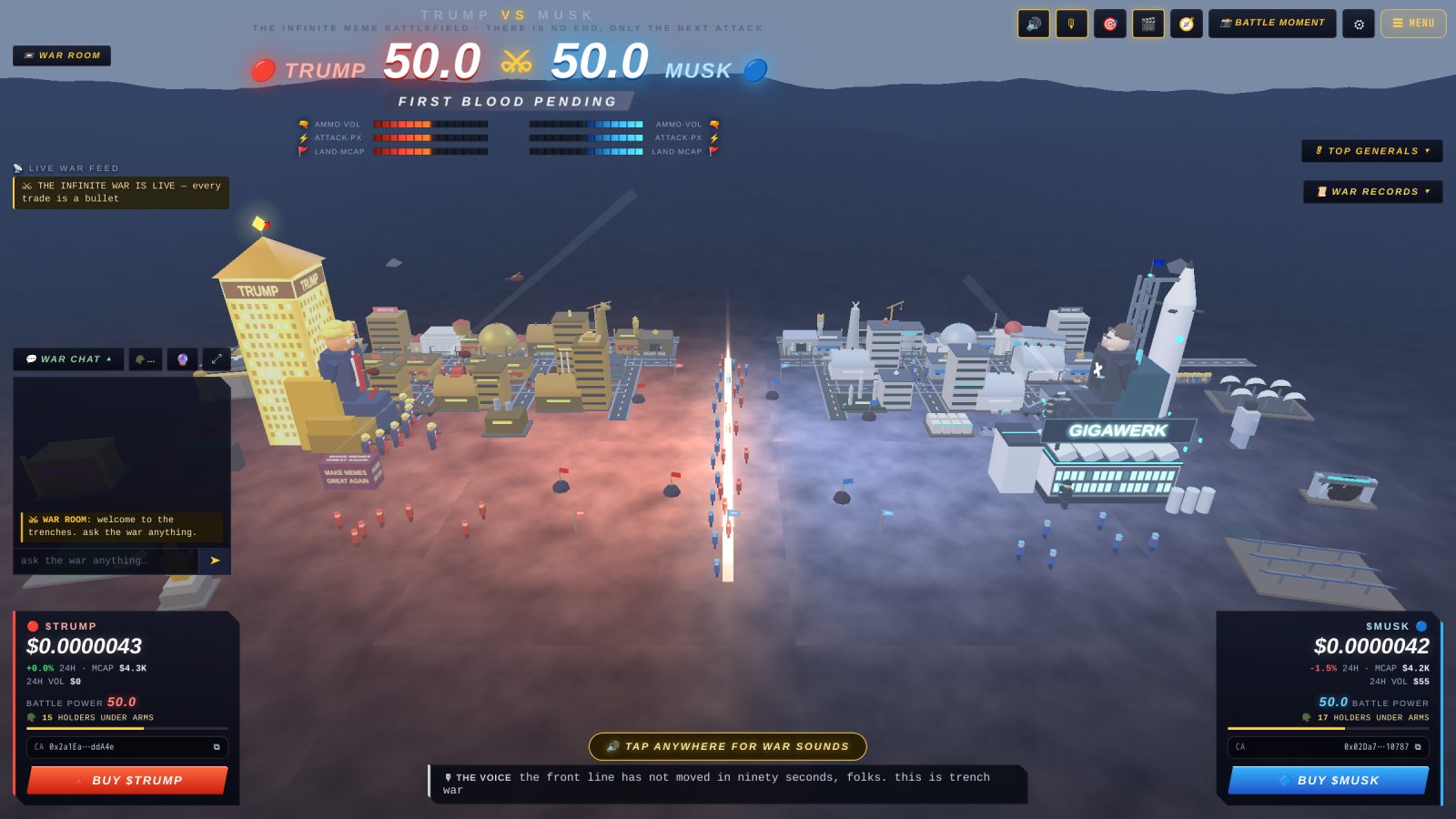
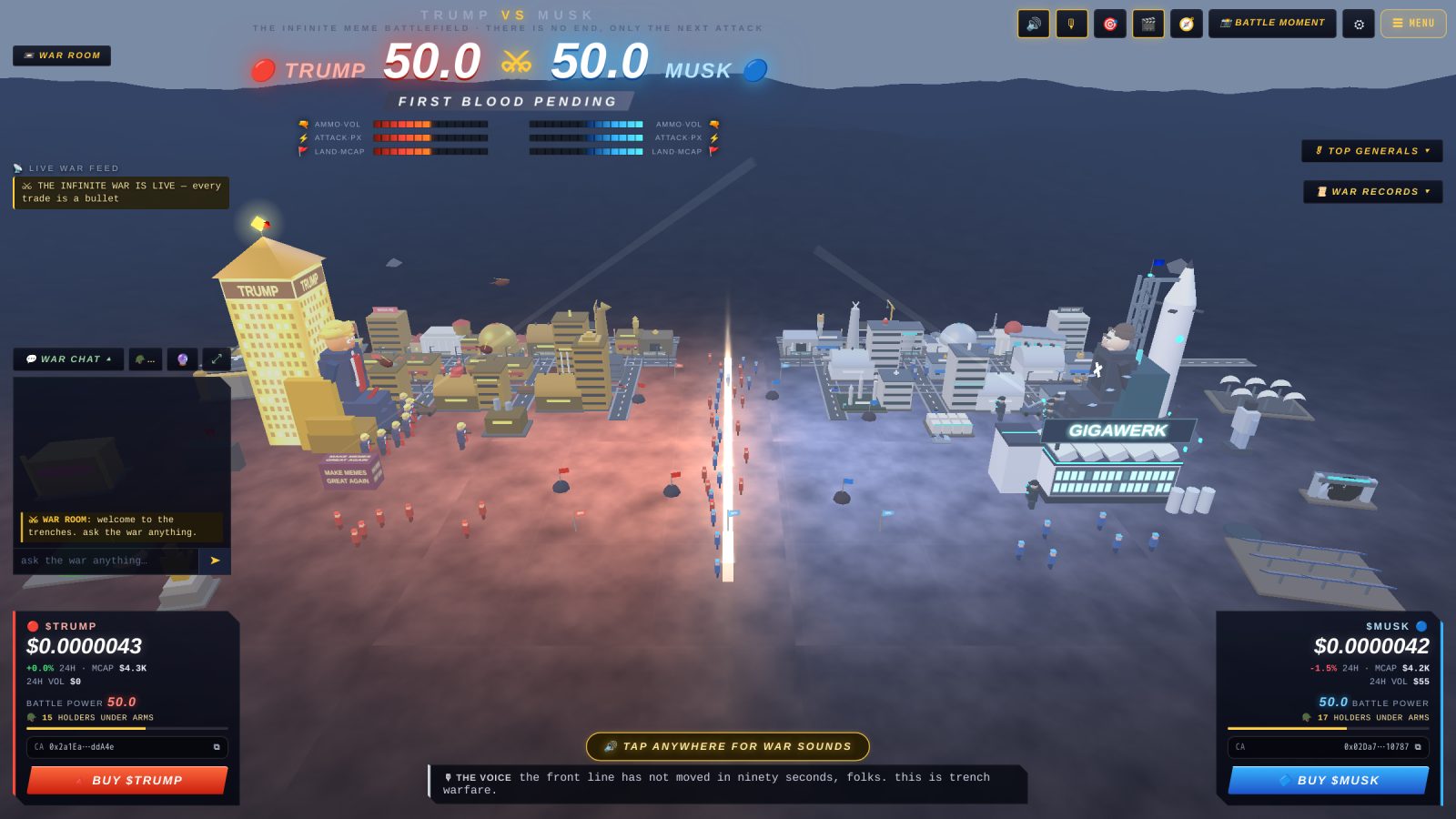
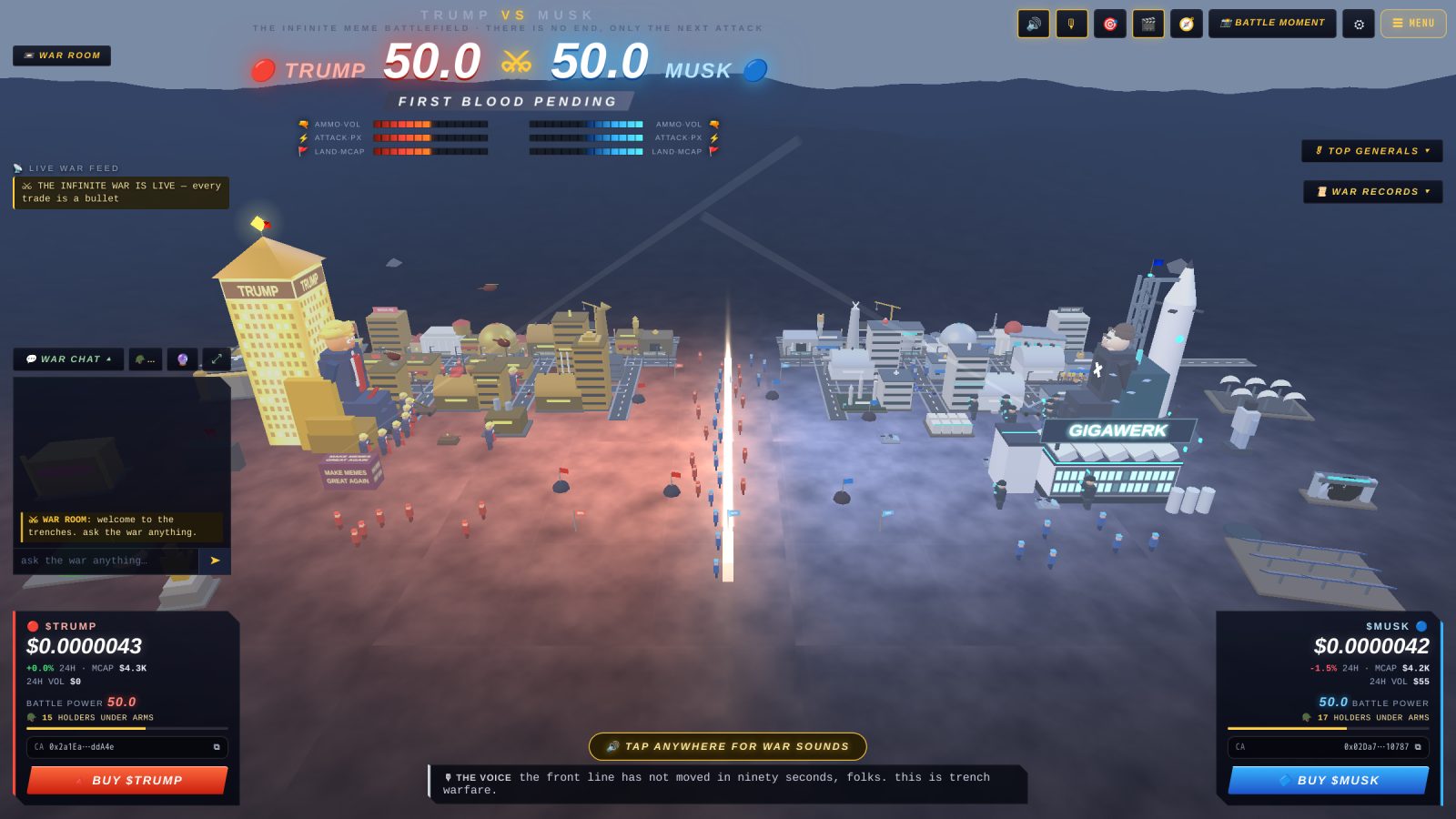
Two caricature armies face each other across an infinite battlefield that fades into the dark at both edges. On the left, a gold tower with a Trump-styled commander sitting on top of it. On the right, a chrome industrial complex, a launch pad and a Musk-styled commander next to the rocket. Between them, a front line that is not decoration — it is a live readout of who is currently winning.
Trades arrive. Small buys send troops forward. Larger ones bring tanks, then helicopters, then airstrikes. The screen reacts to the size of the money, not to a script.
Battle Power, and why it is relative
The scoreboard at the top of the screen is a single number per side, and it is the whole game. Battle Power is built from three inputs:
That last distinction is the one people get wrong, and it is the most important design decision in the whole project. Territory is not awarded for being bigger. It is awarded for growing faster. If Battle Power used absolute market cap, whichever token pulled ahead first would own the map permanently and the game would be over on day one. Everything is measured on a rolling window, side against side.
The practical effect is that a small, fast-moving side can push the line into a much larger opponent’s half — and a dominant side that goes quiet starts losing ground to a challenger doing a fraction of its volume. The lead can flip at any moment, which is exactly the point.
There is also a floor. The front line is soft-capped near 85/15, and a side pinned at its own base triggers a LAST STAND comeback mechanic. No army is ever wiped off the map, because a spectacle with a permanent loser stops being a spectacle.
The detail that earns the most trust: the wash filter
Volume is 40% of the score, which creates an obvious temptation — buy from yourself, inflate the number, march forward on fake ammunition.
The engine filters for it. Every trade the backend reads is classified before it is allowed to count, and the live health endpoint exposes the counters in the open: dust, wash, rateLimited, eligible. Trades that fail those checks are visible to the system and excluded from Battle Power.
It is a small thing that says a lot about the build. The scoreboard is only interesting if the number underneath it is honest.
One holder, one warrior
The armies are not set dressing. Army size mirrors the on-chain holder count one to one. Fifteen holders means fifteen figures standing on that side of the field, and you can count them.
Above a few hundred per side the renderer starts having each figure represent several holders — a browser has limits — and when that happens the HUD tells you the ratio rather than quietly lying about it. Below that threshold it is literal.
The two armies
Both tokens are live on Robinhood Chain, launched via PONS, each paired against ETH in a liquidity pool that is locked at deployment.
$TRUMP ARMY
- Ticker TRUMP — the red side
- Contract:
0x2a1Ea2A208FDbb4407b3610CF2f87CFB39BddA4e - Pool:
0x25a3b04cf2c81bd72d895e1a6712945407fc77a2 - Base: the tower, the flags, the rally
$MUSK ARMY
- Ticker MUSK — the blue side
- Contract:
0x02Da723b03A0CAdd55ea47530817cF7971810787 - Pool:
0xe3eef539a0bafe72694447a32b616b0872bfbded - Base: the launch pad, the gigafactory, the rocket
Both contracts are shown in-game as copy-to-clipboard chips at the bottom of each side’s panel, so you never have to trust a pasted address from anywhere else. Copy them from the battlefield itself and check them against the chain before you do anything.
The broadcast: it talks back
The thing that makes it watchable rather than just readable is that it is running a show.
An announcer calls the play-by-play with real numbers from the live feed. The two commanders sit at their bases and trade insults, in character, in their own speaking styles — Doge jokes from one, chart history from the other. When the field goes quiet they fill the air with trash talk. When a big trade lands they drop it and react to the battle. Troops shout back from the ranks. Scripted exchanges run two to four turns so a setup always gets its punchline, and recurring bits — Doge Minute, War Polls, Sponsor Break — cycle through the dead air.
Under it is a bank of more than seven hundred written lines and six hundred pre-rendered voice clips, plus a live text-to-speech relay for anything containing a number that could not be recorded in advance. A least-recently-used selector picks lines by what you have heard least, with history saved between sessions, so refreshing the page does not restart the same script.
There is also a war chat you can type into, and the show can answer.
Watch it explained in three parts
Three short films, straight from the project. Start at the top.
Part 1 — What it is
Part 2 — How to watch
Part 3 — How to join
What is actually under the hood
The battlefield is not reading a price API and animating a guess. A backend service follows Robinhood Chain directly and decodes swap events out of each token’s PONS pool.
PONS is worth understanding if you are new to Robinhood Chain. There is no bonding curve. A single transaction deploys the token together with a Uniswap V3 pool paired against WETH, and the liquidity is locked at creation. Supply is fixed at one billion. The pool charges a 1% trading fee, most of which is claimable by the creator. Launch protection restricts buys per wallet for the first couple of blocks after deployment, while sells and transfers are never restricted.
The game reads that pool. If the backend loses the chain it does not invent numbers — it falls back to a clearly marked simulated mode rather than showing you a battle that is not happening.
How to watch, and how to take a side
- OneOpen the battlefieldGo to trumpvsmusk.fun and hit play. It runs in a browser tab. Nothing to install, no wallet needed just to watch.
- TwoTurn the sound onTap once anywhere. The show is half the point, and it is muted until you ask for it.
- ThreeRead the scoreboardBattle Power at the top, the three bars underneath it — ammo, attack, land. That is the whole state of the war in one glance.
- FourPick a sideCopy the contract from the in-game chip, verify it, and trade it on Robinhood Chain. Your buy becomes a shot on the field and your wallet becomes a soldier.
- FiveFollow the warLive callouts, biggest-attack clips and flippening alerts post to @TrumpVsMuskFun on X.
Copy the address from the battlefield, not from a screenshot. Memecoin tickers get cloned constantly, and a lookalike contract is the oldest trick in the category. Both addresses are one tap to copy inside the game, and both are printed above. Check the pool matches before you trade anything.
Where it goes next
- Live nowThe infinite battle, the broadcast show, war chat, holder-linked armies, battle-moment share cards and a public changelog of every update shipped.
- BuildingA city system on each side, so the bases grow and take damage instead of standing still — construction that reacts to how the war is going.
- 24/7A dedicated GPU box rendering the battlefield around the clock for a permanent live stream, so the war runs whether or not anyone has the tab open.
- 3 Nov 2026The US midterms, written into the show as an intensifying storyline rather than a one-day gag.
Why it works
Most memecoins ask you to believe in a picture. This one gives the picture something to do.
The genuinely clever move is tying the spectacle to relative performance instead of absolute size. It means the interesting state of the game is the normal state — two sides close together, the line twitching, a flip always one trade away. A leaderboard would have been the obvious build. A war that can be lost by going quiet is a much better one.
It is silly, it is loud, it is deliberately ridiculous. It is also engineered with more care than the joke requires — an honest volume filter, a comeback mechanic, a holder count you can verify by counting soldiers, and a backend that admits when it cannot see the chain. That combination is rarer than it should be.
Watch the war at trumpvsmusk.fun — and turn the sound on. Battle reports, clips and flippening alerts go out on @TrumpVsMuskFun.