

A rapid rally forced short sellers to cover positions, reigniting debate over whether Bitcoin has found its bottom.
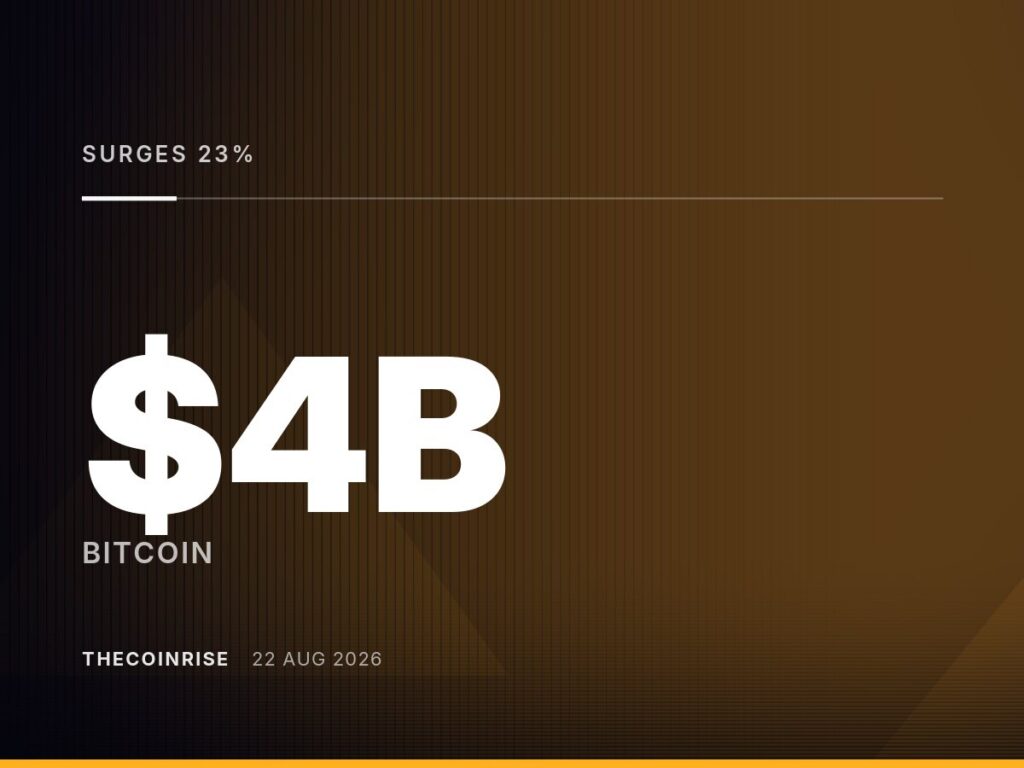
Bitcoin’s price jumped 23% in a fast-moving rally that traders attributed to a large-scale short squeeze. AMBCrypto reported the move coincided with roughly $4 billion in liquidated short positions across crypto derivatives markets. The scale of the squeeze suggests many traders had bet heavily against further price gains before the reversal.
Short squeezes occur when an asset’s price rises quickly enough to force traders holding bearish positions to buy back into the market. That buying pressure can amplify the initial move, creating a feedback loop of rising prices and forced liquidations. In leveraged crypto markets, these dynamics can produce outsized swings within hours.
The timing of the rally has drawn attention because Bitcoin had been under sustained selling pressure in recent weeks. Traders and analysts have been debating whether the asset was approaching a local bottom before this move. A 23% jump of this magnitude raises the question of whether that bottom has now been confirmed, or whether the rally reflects a short-term unwind rather than a fundamental shift in sentiment.
Market participants often distinguish between squeezes driven by genuine buying demand and those driven purely by forced liquidations. The former tends to reflect a change in underlying market conviction. The latter can fade once leveraged positions are cleared out, leaving price action more vulnerable to renewed selling.
Derivatives data showing $4 billion in liquidations points to significant leverage having built up on the short side before the move. Such concentrations of leveraged bets are common after extended downtrends, when traders position for continued declines. When price fails to cooperate, the resulting unwind can be abrupt and sizable, as appears to have happened here.
Bitcoin’s volatility has long been shaped by these leverage cycles. Sharp rallies following heavy short positioning have occurred before, both as precursors to sustained recoveries and as temporary spikes within broader downtrends. Distinguishing between the two typically requires observing how price behaves in the days following the initial squeeze, rather than relying on the move itself.
Sources disagree on this story
This article was published before the reports below were compared. The reporting above stands; what follows is where the published accounts do not agree.
AMBCrypto, CryptoBriefing and NFTevening all describe a violent short squeeze driving Bitcoin toward $80K, but they give conflicting figures for how large the liquidations were and on which day they peaked.
What all sources agree on
- Bitcoin rallied sharply from the low-to-mid $60,000s toward a peak near $79.5K-$80K before settling around $77K.
- The rally was driven by a short squeeze that liquidated a large volume of short positions.
- Bitcoin's RSI reached extremely overbought levels during the move.
Where the reports disagree
1Size of short liquidations on August 19
the crypto market witnessed $2.739 billion in short liquidations on the 19th of August
CoinGlass data at the time recorded approximately $1.57 billion in total 24-hour liquidations, with shorts accounting for about $1.41 billion.
What would settle it: CoinGlass's own dated liquidation dataset for August 19
2Which day saw the largest short liquidation wave, and how large it was
the crypto market witnessed $2.739 billion in short liquidations on the 19th of August, and another $1.265 billion liquidation wave on the 21st of August. It was by far the two biggest short liquidations in 2026.
crypto short liquidations reached $3.07 billion on August 20, the highest single-day level the platform has ever recorded for short positions.
a violent short squeeze that liquidated more than $3B in short positions within a single 24-hour window
What would settle it: CoinGlass's own liquidation records identifying the specific 24-hour window and dollar total
What to make of it
Treat the broad shape of the rally — a squeeze-driven move from the low-$60Ks toward roughly $80K, then a pullback to about $77K — as established, but don't rely on any single dollar figure for the size or exact date of the largest liquidation event until the outlets' CoinGlass sourcing is reconciled.
Market Impact
A move of this size typically affects sentiment across the broader crypto market, not just Bitcoin. Altcoins often track Bitcoin's price action closely, and a sharp reversal can prompt similar short-covering in other tokens. Traders positioned for further downside across the sector may face pressure to reassess their strategies.
The rally could also influence funding rates and open interest on derivatives exchanges, as market participants recalibrate expectations. Whether this translates into sustained upward momentum will likely depend on spot market demand in the days ahead, rather than on the squeeze itself. Analysts caution that liquidation-driven rallies do not always signal a durable change in trend.
Bitcoin's 23% surge highlights how quickly leveraged positioning can reverse in crypto markets. Whether this squeeze marks the start of a sustained recovery or a temporary bounce remains an open question for traders watching subsequent price action.
Frequently Asked Questions
What caused Bitcoin's 23% price jump?
AMBCrypto reported the surge was tied to a short squeeze that liquidated roughly $4 billion in bearish crypto derivatives positions, forcing short sellers to buy back into the market.
What is a short squeeze in crypto trading?
A short squeeze happens when rising prices force traders holding bets against an asset to close their positions by buying it, which can accelerate the price increase further.
Does this rally confirm Bitcoin has bottomed?
It is not confirmed. The move raises the question of a bottom, but analysts note that squeeze-driven rallies can be temporary and require follow-through buying to signal a lasting trend change.
How might this affect other cryptocurrencies?
Altcoins often move in tandem with Bitcoin, so a sharp reversal could trigger similar short-covering and volatility across other tokens in the broader crypto market.