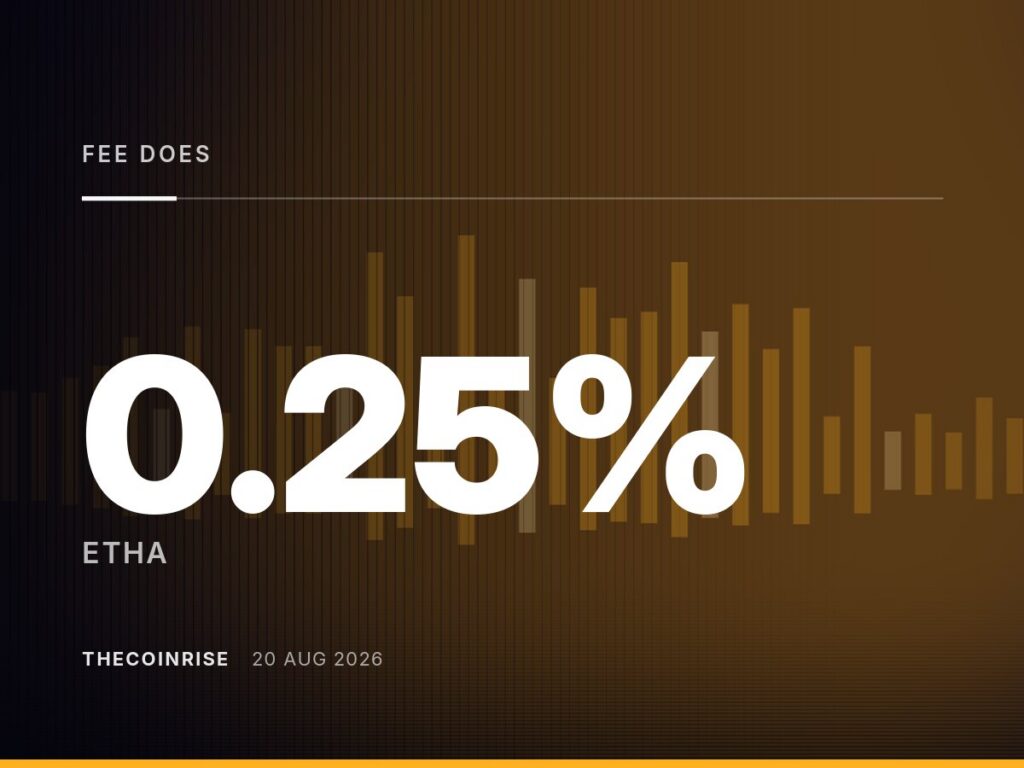


IBIT and ETHA charge the same 0.25% annual expense ratio, according to the Motley Fool’s 24 April 2026 comparison and InvestSnips’ fund table dated June 2026. That fee parity tells you almost nothing else about the two funds: over the trailing year to 22 April 2026 they moved in opposite directions, their asset bases differ by tens of billions of dollars depending on which source and date you check, and neither fund’s public reporting in this evidence set says anything about the trading spread a buyer or seller actually pays.
The fee is identical. That is where the similarity ends.
Both IBIT, BlackRock’s spot bitcoin ETF, and ETHA, iShares’ spot ether ETF, are single-asset trusts that hold only the underlying coin and cash equivalents, according to the Motley Fool. ETHA allocates 100% of its assets to ether, per the same article, and holds no staking exposure – it is a pure price-tracking vehicle, not a yield product. The Motley Fool’s own framing of the comparison is direct: with both funds priced the same, cost is “a non-factor in the decision.” That leaves everything else – size, volatility, track record – to explain why an investor might prefer one over the other.
What the identical 0.25% fee actually costs
crypto.news ran the compounding arithmetic on a flat-price $100,000 position at IBIT’s 0.25% expense ratio, assuming the bitcoin price stays flat so the fee effect can be isolated from price movement. Its table shows that after five years the position is worth $98,756, having paid $1,244 in fees, and after ten years it is worth $97,528, having paid $2,472 in fees. crypto.news’s own summary paragraph gives a different figure for that same ten-year cost – “approximately $2,528” – an internal inconsistency in the source itself that this page flags rather than resolves; the table’s arithmetic ($100,000 minus $97,528 equals $2,472) is the figure used below. That math was computed for IBIT specifically, using IBIT’s own fee and crypto.news’s method. No source in evidence runs the equivalent ten-year calculation for ETHA. Because ETHA’s expense ratio is the identical 0.25%, per the Motley Fool and InvestSnips, the same mechanical result would follow for a flat-price position of that size held in ETHA – that is this page’s own arithmetic extension, not a figure either fund or any source has reported for ETHA specifically.
Put another way: the fee drag on either fund, held flat for a decade, is a little under 2.5% of the original position. That is a fixed, mechanical cost. It is separate from – and much smaller than – the price swings both funds have actually produced.
Where the two funds actually diverge
The Motley Fool’s snapshot, dated 24 April 2026, shows IBIT down 14.1% and ETHA up 40.7% over the trailing 12 months to 22 April 2026 – a gap the article attributes to how differently bitcoin and ether moved over that period, not to any difference in fund construction. IBIT’s assets under management stood at $63.7 billion versus ETHA’s $7.6 billion in the same article – a ratio of roughly eight times, calculated by this page from those two figures rather than a comparison the Motley Fool draws itself. A separate source gives a lower figure for IBIT: crypto.news, in an article dated 19 August 2026, puts IBIT’s AUM at “over $23 billion.” The two numbers come from different dates – April and August 2026 – and neither is reconciled here; a reader checking IBIT’s current size should look at the fund’s own factsheet rather than either snapshot.
Risk profile also diverges. The Motley Fool’s comparison table lists ETHA’s one-year max drawdown at -64.02% against IBIT’s -49.36%. Notably, the article’s own body text separately states ETHA’s drawdown at -61.66% – an internal inconsistency in the Motley Fool piece itself, and a reminder that even a single outlet’s numbers on the same fund can conflict within one article. The table also shows that a hypothetical $1,000 invested in IBIT a year earlier would have grown to $859 by the article’s date; no comparable dollar-growth figure is given for ETHA in that table.
ETHA’s fund age was 1.8 years as of the Motley Fool’s 24 April 2026 article, reflecting its mid-2024 launch and a shorter track record than longer-tenured bitcoin funds – a fact the article itself flags as a data limitation, not a quality judgment.
A second source complicates the size picture further. InvestSnips, in a fund table dated June 2026, lists ETHA’s AUM at an estimated $16.1B and its one-year return at +13.9% – both figures conflict with the Motley Fool’s $7.6 billion and +40.7%. InvestSnips itself labels its AUM column “Est.” and warns that 2026 AUM figures are “highly volatile based on institutional rotation between spot and staking products.” The two sources use different snapshot dates – April versus June 2026 – and different methods, and neither number should be treated as settled without checking the fund’s own current disclosure.
InvestSnips’ same table gives useful comparison points among other ether funds at that June 2026 date: Fidelity’s FETH at a 0.25% expense ratio with $1.9B in AUM and a 13.5% one-year return; Grayscale’s legacy ETHE at 2.50% with $3.2B in AUM and a 12.1% return; and Grayscale’s lower-cost Ethereum Mini Trust at a 0.15% expense ratio. Staking-enabled ether ETFs, a separate category InvestSnips covers, carried a staking yield described as typically 3.8% to 5.5% as of that table – ETHA does not participate in that yield, since it holds only spot ether and cash, per the Motley Fool.
The self-custody alternative
Both fund wrappers exist because most investors don’t want to manage a crypto wallet. The Motley Fool notes that holding either ETF inside a brokerage account means no private-key management and no exchange risk, and that ETF shares are eligible for tax-advantaged accounts such as IRAs in a way direct crypto holdings generally are not. The trade-off, per the same article, is giving up 24/7 trading, being unable to move the underlying asset, and paying the 0.25% annual fee indefinitely – a cost a self-custodied wallet does not charge.
crypto.news quantifies the self-custody side of that trade for bitcoin: a hardware wallet costs between $79 and $219 as a one-time expense, versus an ETF’s recurring annual fee. No comparable one-time cost figure is given in evidence specifically for an ether hardware wallet setup, though the mechanics – a single upfront hardware cost against a recurring expense ratio – would be the same.
What this page does not tell you
No source in this evidence reports the bid-ask spread for IBIT or ETHA – the actual cost of buying or selling shares in the market, separate from the annual expense ratio. That is a real gap in the original question this page was built to answer, and it is not filled here with an estimate.
Fund-specific, numeric tracking error – how closely a fund’s share price follows its underlying reference index day to day – is only available in this evidence as an aggregate range of 0.03% to 0.42% annualized across 11 U.S. spot bitcoin ETFs, per crypto.news. That figure does not isolate IBIT, and no equivalent number exists in evidence for ETHA or any other spot ether ETF. InvestSnips does describe ETHA’s tracking error against the CME CF Ether-Dollar Reference Rate as “minimal,” but that is a qualitative characterization with no figure attached, made in the same article that carries an “Editor’s Choice” badge for ETHA – it is reported here as InvestSnips’s own description, not as an independently verified measurement.
AUM and one-year return figures for ETHA conflict between the Motley Fool ($7.6 billion, +40.7%, snapshot dated 22-24 April 2026) and InvestSnips ($16.1B estimated, +13.9%, dated June 2026). The two use different dates and, per InvestSnips’ own disclosure, different estimation methods. Neither is corrected against the other here; both are reported with their source and date so a reader can judge which is closer to current reality by checking the fund’s own factsheet. IBIT’s AUM shows a similar conflict: $63.7 billion per the Motley Fool (April 2026) against “over $23 billion” per crypto.news (August 2026) – again, different dates, both reported rather than resolved.
InvestSnips presents itself with promotional framing – an “Editor’s Choice” badge and checklist-style marketing copy – and is treated in this page only as a source of leads and self-disclosed estimates, never as independent confirmation of a fact reported elsewhere.
Finally, the ten-year fee arithmetic above assumes a flat coin price, an assumption crypto.news states explicitly to isolate the fee effect, and it was computed for IBIT, not ETHA – the ETHA figures given are this page’s own extrapolation from the shared 0.25% rate, not a reported calculation. Real returns for both funds, as shown by the Motley Fool’s one-year figures, have been far from flat – so the fee drag is a small, predictable slice of a much larger and unpredictable price swing, not the dominant factor in what an investor actually keeps.
Sources
Every fact above is attributed to one of these reports. Where they disagree, the article says so.